missing & murdered indigenous persons
The Anchorage Police Department (APD) works in coordination with local, state, and federal partners to investigate cases involving Missing and Murdered Indigenous Persons (MMIP) in Anchorage. This page provides information, resources, and a public dashboard to increase awareness and support efforts to locate missing individuals.
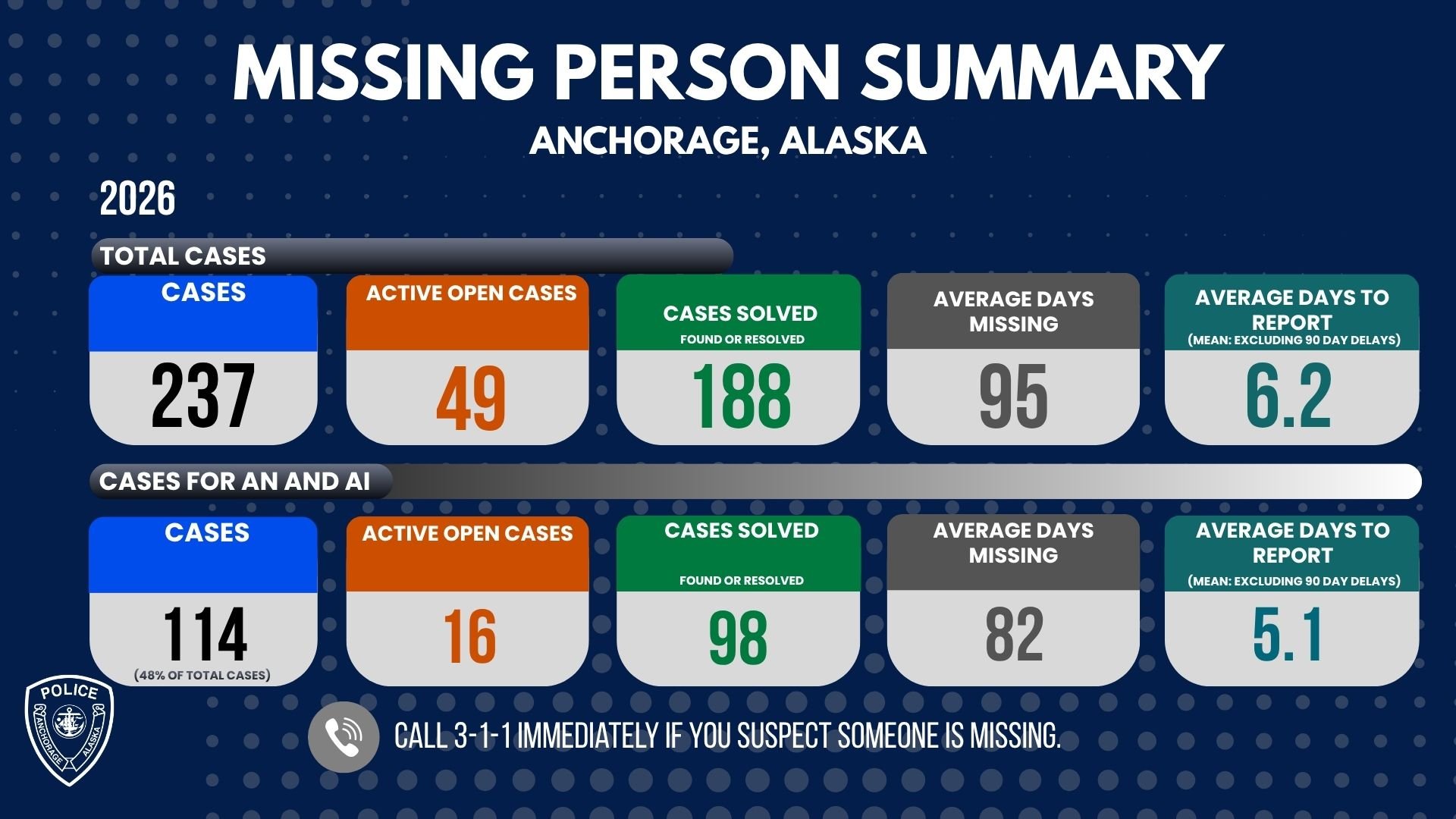
The first row represents the total number of missing persons cases since May 11, 2026. The second row represents the total number of missing persons cases involving individuals who are Alaska Native (AN) and American Indian (AI).
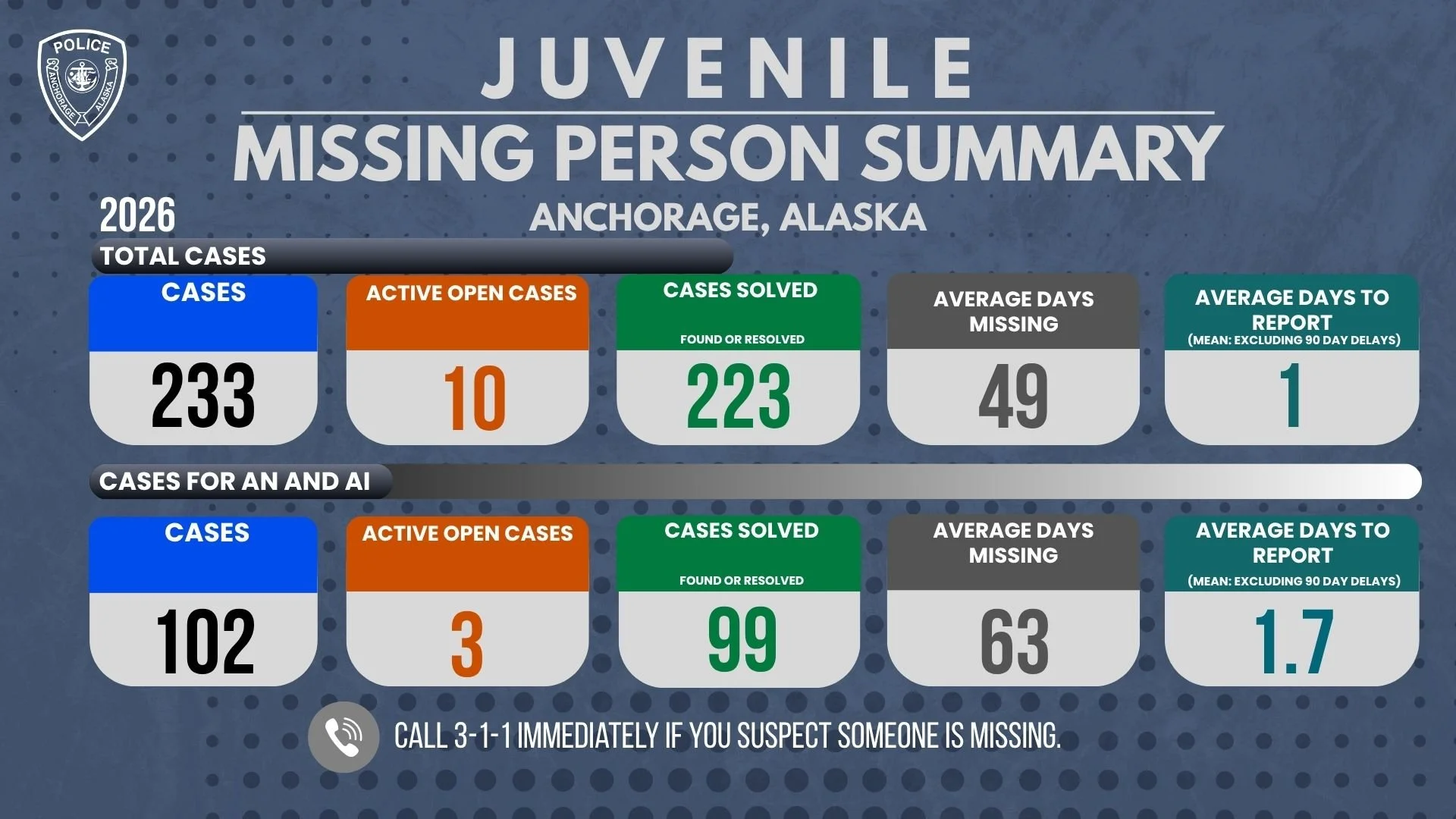

Each year, 2023 - 2026, has the total solve rate and the solve rate specific to cases involving people who are Alaska Native (AN) and American Indian (AI).
Anchorage Police Department’s MMIP Action Plan
APD is focused on action, maintaining ongoing commitments, and has established future goals for MMIP. Read highlights of the APD Public Action Plan & Accountability Roadmap for our Immediate Action Initiatives, Ongoing Commitment, and Future Goals. The MMIP Public Action Plan was compiled and written by Chief Sean Case, with support from staff.
Please email apdchief@anchorageak.gov with feedback on the plan.
-
No waiting period — every missing persons report is taken immediately upon contact
Officers respond to the scene on every missing persons call
Mandatory in-person response required when a missing person is located
All cases entered into APSIN, NCIC, and NamUs databases
-
Launched public MMIP dashboard on the APD website
Missing persons data broken out specifically for Alaska Native individuals
Regular updates published on case resolutions and trends
-
Full compliance with federal guidelines for missing and murdered Indigenous persons.
Timely data sharing with state and federal partners.
Standardized response protocols for Indigenous cases.
About Savanna’s Act (2020): Federal legislation directing agencies to develop and implement protocols to respond to cases of missing or murdered Indigenous women and girls and to improve data collection on those cases.
-
APD is committed to keeping families informed throughout every investigation and to handling public communication with care and dignity on their behalf.
-
Cultural competency and trauma-informed training for officers and dispatchers
Bias awareness training specific to Alaska Native communities
Review of past MMIP cases to identify areas for improvement
-
Establish a dedicated MMIP / Tribal Liaison position within APD
Create a multi-agency MMIP response team
Further strengthen two-way communication with the Alaska Native community
Frequently Asked Questions & Resources
-
-
If you have case information, your first and most important step is to call dispatch at 3-1-1 or 786-8900 and request to file a report. If you want to follow up, please call the appropriate division commander. The case detective will follow up with you if they need additional information. This process allows detectives to remain focused on their cases.
-
We appreciate the public’s assistance with cases. However, sending chain emails to multiple employees is generally not the most effective way to receive case updates. If you have information to share about a case, the best way to share that information is to call the non-emergency line: 311. You can also email the appropriate Division Commander rather than the detective working on the case. Chain emails sent to multiple staff members can create duplicate responses and divert valuable time and resources away from ongoing investigations and other public safety responsibilities.
-
When appropriate, and when it meets certain criteria, APD partners with Alaska Search and Rescue Dogs.
-
The Anchorage Police Department works to connect families with appropriate resources.
Download the guide for support services.
Download MMIG2s Alaska Working Group Resource Booklet
Alaska Native Women’s Resource Center: https://www.aknwrc.org/
-
The State Medical Examiner determines the cause of death and manner of death. The manner of death is an official classification of the circumstances surrounding how the cause occured.
The Anchorage Police Department does not determine the cause, nor does APD classify the manner of death.
Go here to download a resource guide that can help to navigate these questions.
You can also contact United Way of Anchorage by calling 211 or 1-800-478-2221 if you are outside of the Anchorage area.